

13 Aug 2021, last revised 09 May 2026
In the early 1900s, the mining industry was nearing its peak production years (6) and Houghton County was nearing its peak population of over 88,000 (5). So even though there were two well-established breweries in Houghton, the A. Haas Brewing Co. and the Scheuermann Brewery, local capitalists felt there was room for one more. After some back-and-forth negotiations, however, the Park brewery was built in Hancock instead of Houghton.
Plans for a New Brewery
In Apr 1906, Joseph Haas was organizing a stock company with others to build and operate a brewery in Houghton, with the proposed site being Haas Park (17). Joseph, formerly of the A. Haas Brewing Co., owned and resided at Haas Park (17). The Park Brewing Co. was incorporated by Joseph Haas, William H. McGann, Frank Voith, R. Rourke, F. C. Toelle, and E. R. Batherick with a capitalization of $150,000 divided into $100 shares (25). Papers of association, filed with the county clerk on 21 May 1906, stated that the company was incorporated for "the purpose of manufacturing and selling ale, beer, porter and other malted and brewed liquors..." (1). The organizers elected officers: Joseph Haas, president; Richard Rourke, vice president; Frank J. Voith, secretary; and William McGann, treasurer (20). The company was named The Park Brewing Co. after the fact that it was intended to be located at Haas Park (39).
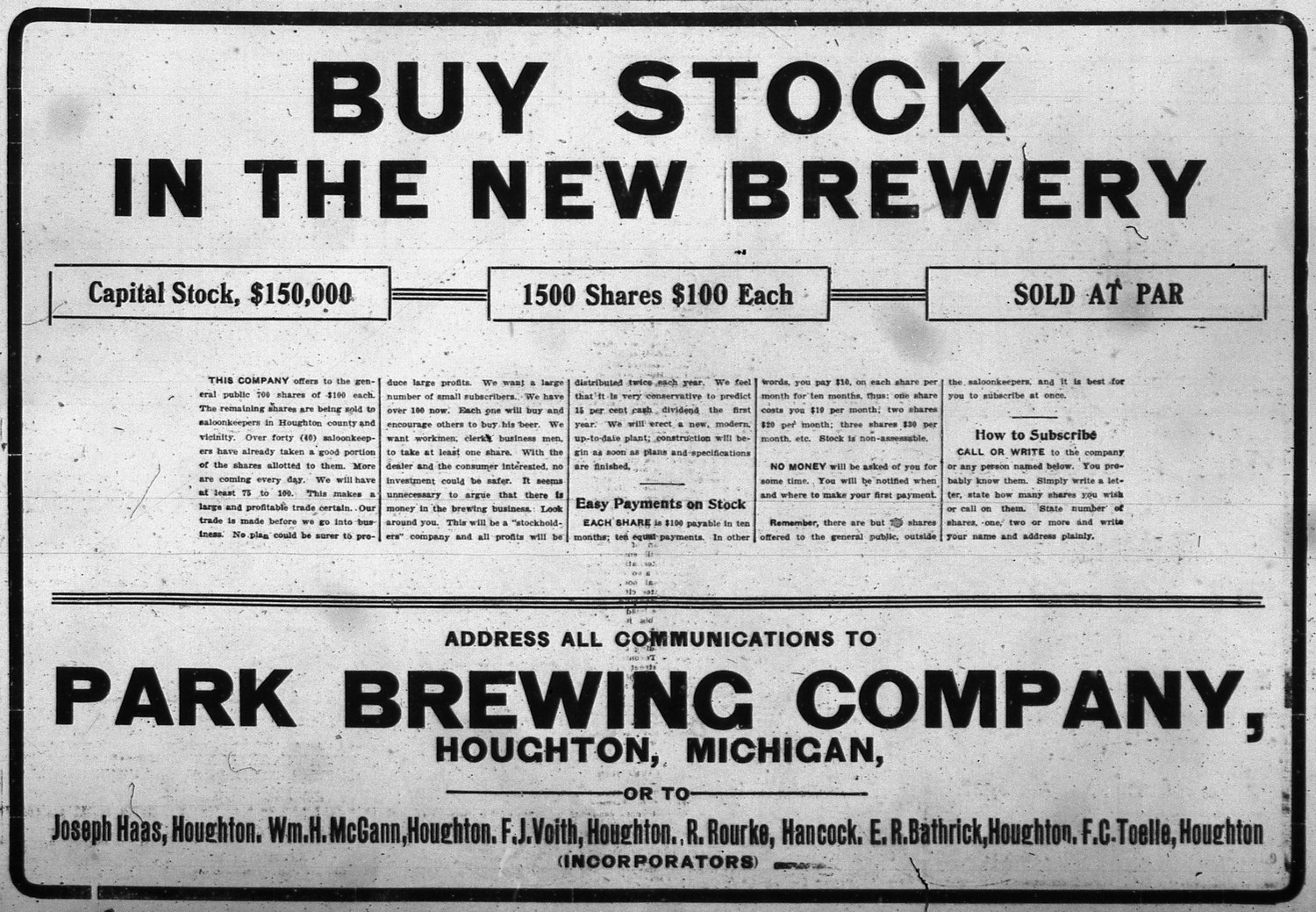
Newspaper ad – May 1906
At a meeting of the Hancock Businessmen's Association in May 1906, the council was asked if Hancock could donate a site for the brewery since most of the businessmen involved preferred the brewery to be in Hancock (19). Batherick stated that "the enterprise is already an assured success" (27). Mayor A. J. Scott, who had a drug store in Hancock (see Scott's Drug Store), thought the city could donate a site from the land near Anthony's farm (19). The promoters visited the site, and Mayor Scott said the city would sell three acres for $1, allow the use of water for free, and exempt the brewery from taxation for a period of five years (13). Before visiting the Hancock site, the company had already decided on the Haas Park site and thanked Scott heartily for the generous offer (13). It was Hancock's interest that allowed the company to leverage many concessions with the Haas Park site (13). But then in early Jul 1906, Joseph Haas withdrew from the company and the deal to build at Haas Park was off (21).
The promoters' next move was to petition the Hancock city council to deed a site for a nominal price or to lease land on the lakefront near the city pumping station for 99 years at low rent (22). In response, many businessmen and residents expressed their opposition to selling or leasing the lakefront property, citing concerns that the city water would be contaminated (23). They also felt that the city should not sell or lease land for less than full value with no exemption on taxes (23). At the next city council meeting, Batherick reported that the company had purchased a site in Hancock and did not want free water, taxes, or light (24). The property was purchased on 06 Jul 1906 (26) for $3,100, which was $6,900 less than the asking price for the Haas Park site (11). It consisted of seven lots in the Condon addition in west Hancock, and it was bounded by Railroad Ave., Ethel Ave., Emma Ave., and Atlantic St. (26).
A. J. Scott accepted the nomination for president of the company in Jul 1906 (10). By early Aug, stockholders consisted of over 80 saloon keepers and about 250 men in the liquor trade (11). The organizers would take their pay in stock (11). The officers would not collect a salary for the first year (19).
Construction of the Brewery
In Jun 1906, the organizers went to Detroit and Cleveland to arrange to purchase the construction material and machinery for the brewery (18). The concrete foundations and railroad spurs were laid, but construction of the brickwork could not commence until the architect delivered plans revised for the Hancock site, which happened in late Aug 1906 (28). In late Sep 1906, the cornerstone inscribed with "Park Brewing Co." was laid and a time capsule containing newspapers, the officers' names, and cards of several spectators was sealed up in stone (30). In Nov 1906, the main building was ready for the construction of the third story, and the washhouse and boiler room were ready for a roof (31). The bottling plant and offices would be separate buildings (29). In Mar 1907, Scott, Voith, and McGann went to Chicago to purchase supplies for the brewery, including barrels, bottles, and cases (32).
Completed by early Jul 1907 (33), the brewery building was 100 x 100 ft and five stories at its highest section (40). Construction consisted of a frame of iron and steel, floors of asphalt and concrete, and walls of brick with compressed cork insulation and plaster (33). The only wood to be found was for the doors and windowsills (33). Equipment was installed as it arrived (33). The first floor had a boiler room, engine room, washroom, racking room, and cellars (40). The boiler room in the rear held a 150-horsepower boiler that supplied power for the entire brewery (33). The adjoining engine room held a 30-horsepower generator, a 20-horsepower engine to drive the malt machines, malt mills, elevator, and other equipment, and a 60-ton refrigerating (ice) machine (33,40). A water-jacket beer cooler, held either in the same room or another room, cooled the beer in pipes after brewing (33,40). A sheet-iron grain bin, with nearly a 10,000-bushel capacity, was 10 ft in diameter and 35 ft high, extending up to the fourth floor (33). The settling cellars contained a brine tank that held brine used to maintain the temperature of the beer and two 124-barrel-capacity, glass-enameled tanks, which held the beer for 20 to 30 hours before it was pumped into the fermenting cellars (33,40). The fermenting cellars contained six 120-barrel-capacity vats made of glass-enameled steel (29,40). The chip cellars contained ten 125-barrel-capacity tanks (40), in which birchwood chips would draw out any toxins from the beer (33). The stock cellars contained 250-barrel-capacity tanks (40). In the racking room, beer was pumped into barrels and kegs (33). The washing room was where kegs and utensils were washed (33). A brew room and a hop room on the second floor held a 115-barrel-capacity solid copper brew kettle with an airtight lid, a wash tub for washing malt, a 120-barrel-capacity mash tub, and a 165-barrel-capacity hot-water tank that boiled all the water used for brewing (33,40). The third floor had a malt mill with a flake hopper, grits kettle, weighing hoppers, and other equipment (33,40). The fourth floor held a 165-gallon cold-water tank and malt storage bins (40). The fifth floor had a condensing room where ammonia used for refrigeration was cooled back to liquid form (40).
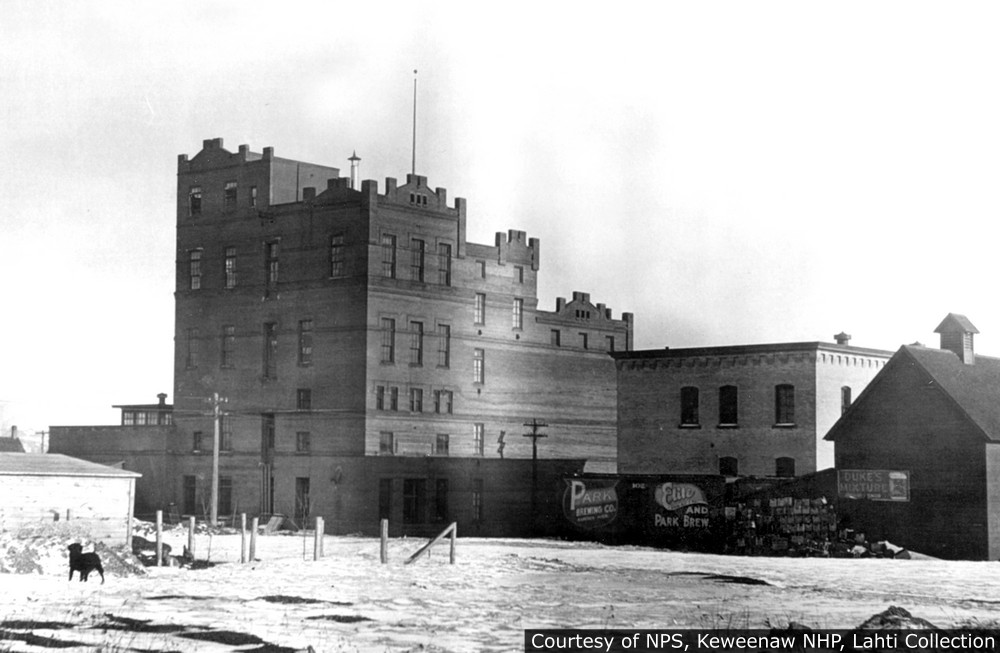
Park brewery, c. 1910

Park brewery, c. 1935
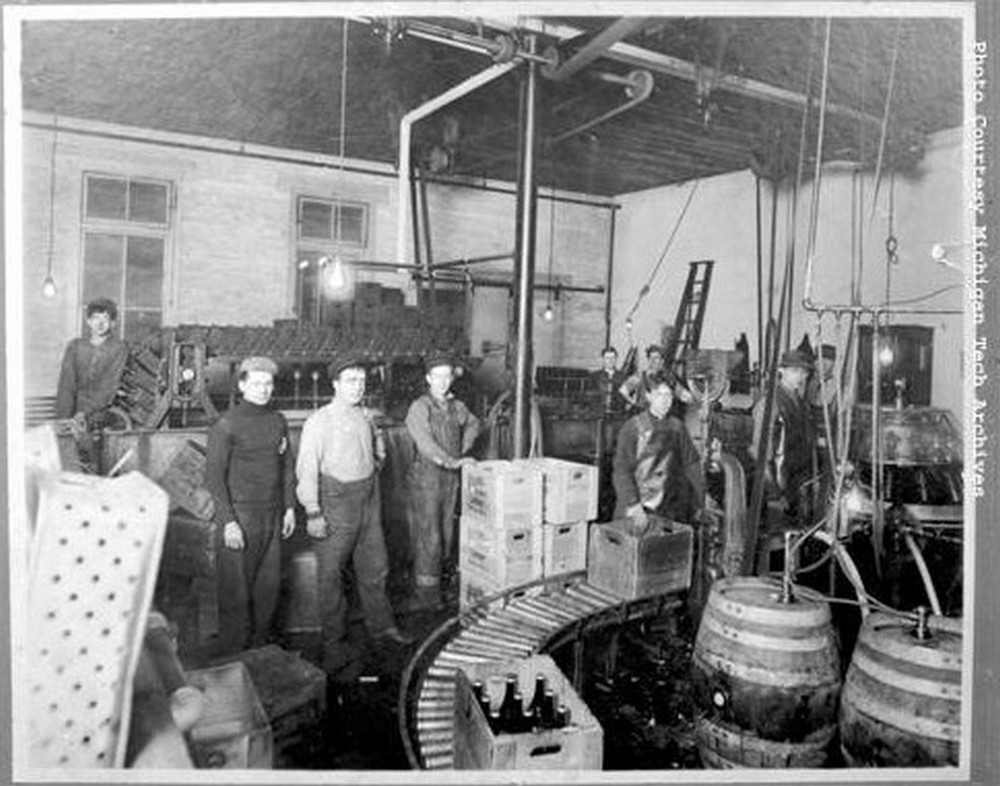
Bottling Operation
Construction of the Bottling Works
In addition to the brewery, the company also needed a bottling works. In Jul 1907, the company purchased three lots across Atlantic St. to be the site for the bottling works (34). Being separated by a wide roadway complied with requirements stating that the bottling department had to be separated from the brewery by a considerable distance to avoid contamination during the bottling process (34). The bottling room floor and walls of the first story would be concrete, and the rest of the building would be built of brick with sandstone trim (35). The floor of the basement would be concrete (40). The basement would be used for storing bottles and shooks (40). The main floor would contain the bottling machinery and an office (40). The second floor would be used for storage and a cooperage shop (35,40). A large freight elevator would be installed (35) and a platform would extend from the building to facilitate the loading of wagons and cars (40). The building would be operated by electricity (35). Construction was expected to be completed no later than the middle of Dec (42). Sanborn maps show the brewery on the corner of E. Atlantic St. and Emma St., with the bottling works across the street.

Sanborn map – Nov 1907

Sanborn map – Aug 1917
Time to Brew
With the brewery building constructed, it was nearly time to start brewing and set plans to market the beer. The brewmaster, Charles Huhn, arrived from Chicago on 02 Jul 1907, and after the remaining machinery was installed, brewing could commence (33). In Aug 1907, the directors appointed McGann as manager and Voith as assistant manager (35). The first beer was made on 22 Aug 1907, and it was expected to be ready for market in late Nov (36). By mid-Nov, McGann had established branches in the principal towns of the Copper Country (39). The day finally arrived, 15 Nov 1907, when the company placed its beer on the market, and it could be found on tap in almost every saloon in Houghton County (41). About two weeks later, Baraga County received its first shipment (2). The company's ads specified that its beer was called Park Brew.
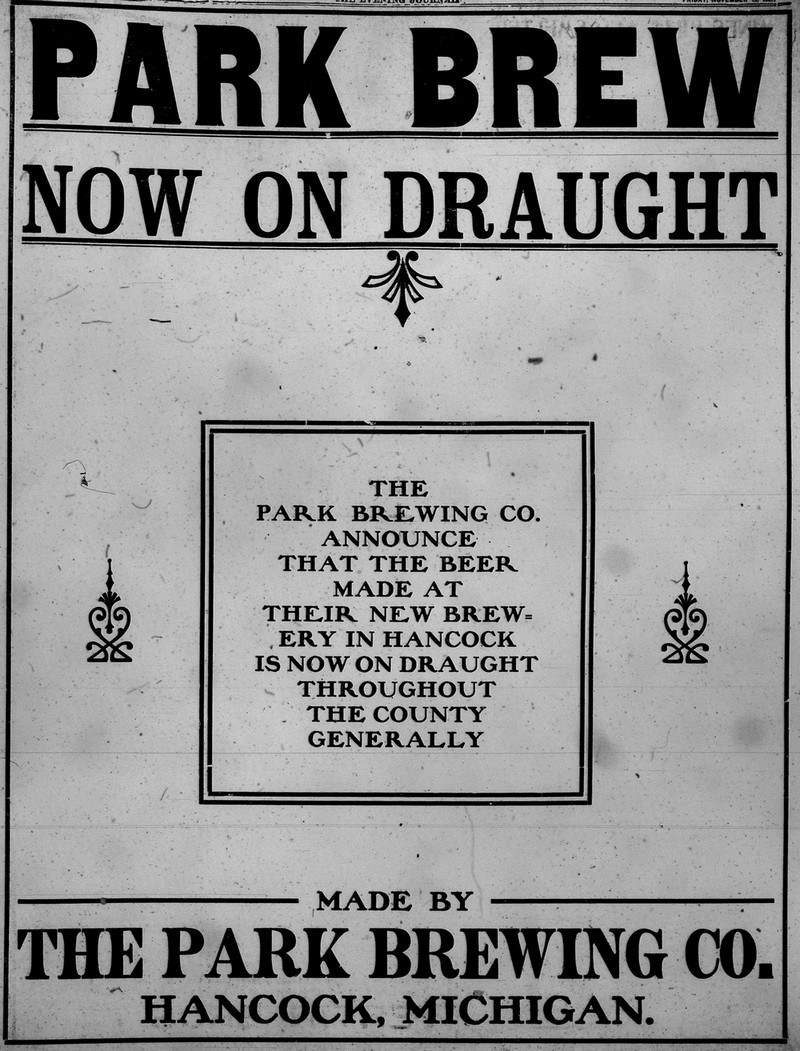
Newspaper ad – Nov 1907
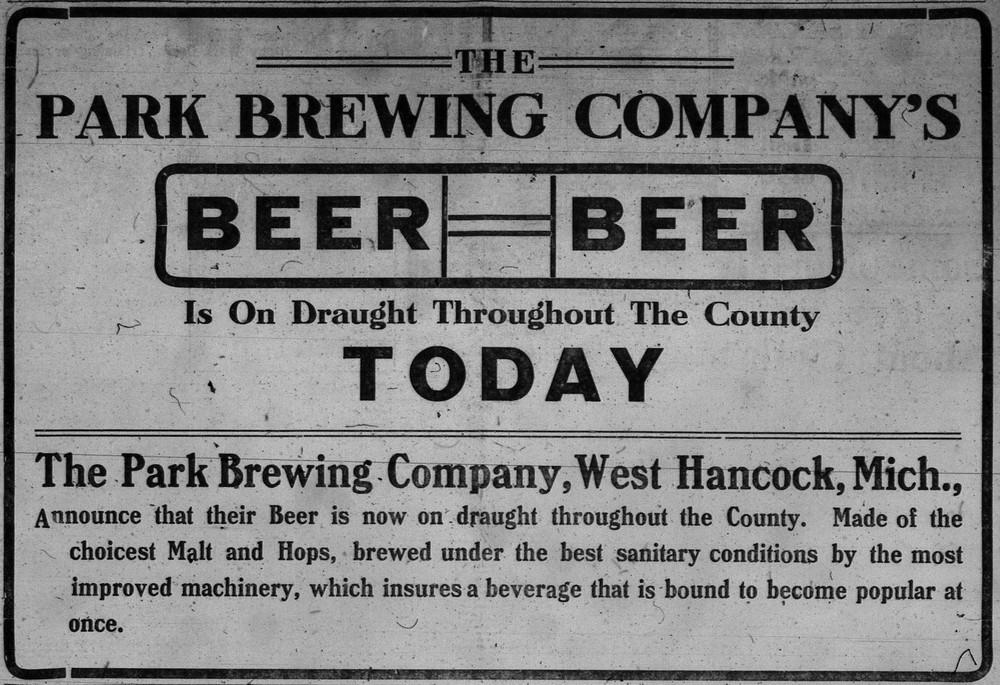
Newspaper ad – Nov 1907
The company first released its product in bottles a few days before 01 Jan 1908 (43), meaning its first bottle dates to 1907. The bottling works was practically completed by 21 Feb 1908, with only some interior painting remaining (44).
Business Matters, Growth, and Expansion
The company's main offices were established in Houghton, since that was where the company was organized and incorporated, and at the time, it was understood that the brewery would be built in Houghton (37). But because the brewery was built in Hancock, some stockholders felt that the offices should also be there (37). In Nov 1907, the stockholders voted unanimously to move the head offices to Hancock, to be located at the brewery (38). By 01 Jan 1908, the company had moved its offices into temporary quarters at the bottling works (43).
In late Jan 1908, the company decided to double the capacity of its plant and ordered the appropriate equipment (45). The building was constructed to accommodate such growth, but it was not expected to be necessary so shortly after marketing its product (45). A month later, several carloads of cooperage arrived (44), and about a week later, 16 large, glass-lined steel storage tanks arrived (44,46). At this time, the directors decided to purchase a new duplicate boiler (46).
The stockholders held their annual meeting in May 1908 (8). The officers were re-elected and they, along with William C. Kauth, composed the board of directors (8). The company had 100 stockholders, nearly all from the Copper Country (3). The brewery cost approximately $186,000 to construct (3), and it was running at full capacity (8). The only construction expected for the season was the stables, and its foundation had already been laid north of the brewery (8). It was expected that the remaining small debt would be paid and dividends would be issued within a few years (4).
The brewery quickly required further expansion to meet increasing demands (47). In Jun 1908, stockholders authorized the issuance of bonds of up to $50,000 with plans to build a barn and a cooling room (47), and to expand warehouse capacity (48). The company also planned to purchase new equipment and five horse teams with wagons (47). It was also noted that if malt, barley, cooperage, and other supplies could be purchased with cash at a reduced price (47), the money saved would offset the interest on the bonds (48). In Mar 1909, construction of the barn was planned for the summer, and it would be able to accommodate 12 horses (49). It is unknown if the barn was constructed.
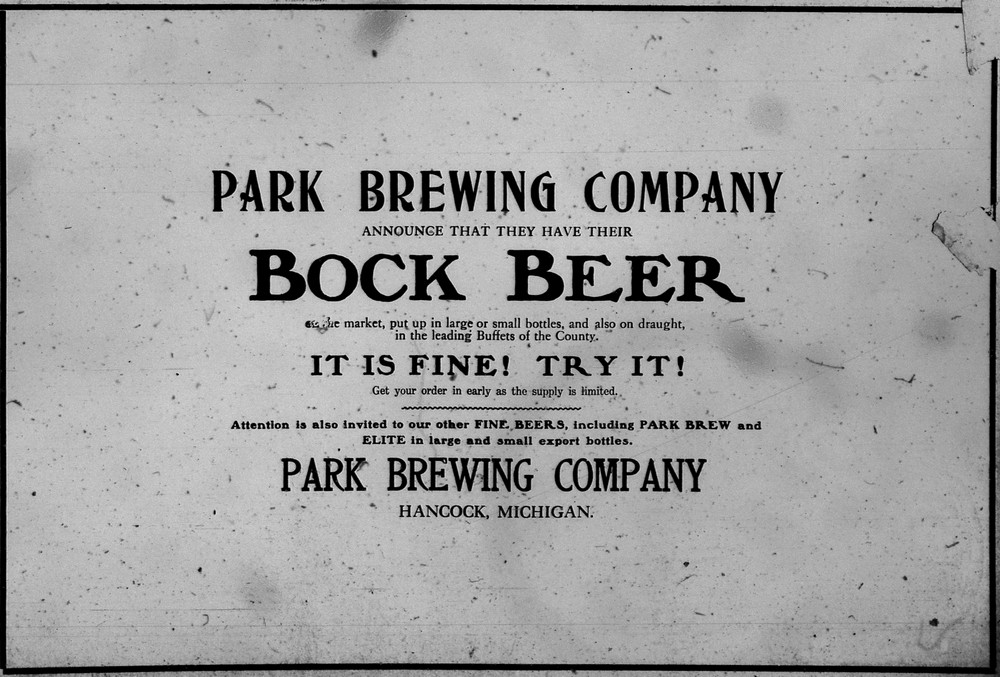
Newspaper ad – Mar 1909
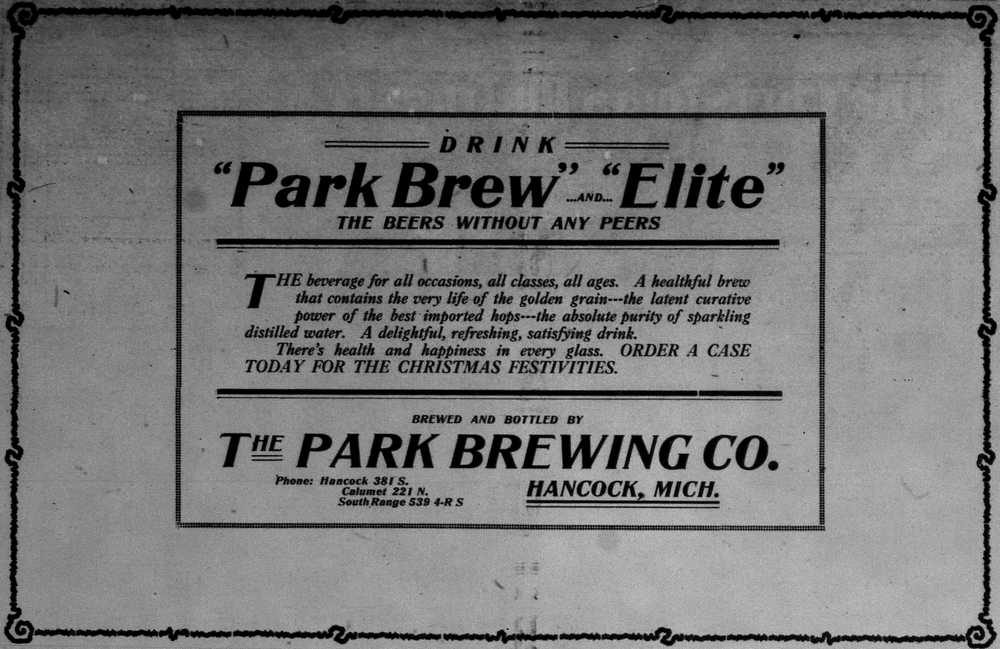
Newspaper ad – Dec 1909
The board reported in Aug 1909 that they had their best quarter, with growing demand and constant expansion of distribution (70). In Sep 1910, the directors declared the first dividend for the company, which would be three dollars per share (50). At this time, the company had two brands, Elite and Park Brew, as well as a porter (50). An ad (see above) indicated that the company also made bock beer. The company had branches in Laurium and South Range (50).
At the May 1911 annual meeting, A. J. Scott resigned as president and new officers were elected: D. J. Norton of Ontonagon as president, James Vignetto of Laurium as vice president, and William H. McGann of Houghton as secretary, treasurer, and general manager (9). In addition to the officers, new members of the board of directors were elected: A. B. Saxby and Louis T. Saam, both of Hancock (9).
The brewery had 31 employees in 1910 (14) and 19 employees in 1917 (15).
In 1913, 20 unionized employees went on strike with the following demands: employ only union men, a 9-hour workday and a 6-day workweek, time-and-a-half overtime pay, higher wages, and no hiring based on a saloonkeeper's recommendation (12). With the support of striking copper miners, the workers got their demands and went back to work (7).
Bottle Embossing
Some of the bottles are embossed with THE PARK, while others have only PARK. It seems these two designs alternated several times and extended into the ABM period. The aqua bottles likely contained a special brand of beer, as aqua bottles did for other breweries. This special brand was likely Elite, since the Elite paper label has been found on unembossed aqua ABM bottles.
Prohibition Hits Michigan
After Michigan state prohibition commenced on 01 May 1918 (51), the brewery tried to stay open by manufacturing "soft drinks" (16) but then closed in 1918 (7). National prohibition went into effect on 17 Jan 1920 (52).
Post-Prohibition Revival
National prohibition law was amended to legalize the sale of beer and wine with 3.2% alcohol by weight, effective 06 Apr 1933 in states without state prohibition laws (53,54). Michigan followed by legalizing such beer and wine on 27 Apr 1933 (55). Breweries first needed to obtain a state license and a federal permit before they could start manufacturing beer (55,56).
The Park brewery reopened, but only after changes in ownership and protracted renovations. W. O. Baysinger and associates of Milwaukee purchased the Park brewery building (57) from the A. Villanelli Oil Company (58) and started extensive renovations and repairs in Aug 1933 (57). Their plans included erecting a one-story addition to house offices, a car garage, a storage room, and a workshop (59,60). The new Park Brewing Co. offered 150,000 shares of common stock for sale in Aug 1934 (61) and contracted for new equipment in Oct 1934 (62).
In Jan 1935, five Hancock men, Joseph Rock, A. Villanelli, Angelo Vignetto, Narciso Ricomini, and Giulio Maneschi, purchased a controlling interest in the company from W. O. Baysinger and associates and would soon prepare the building for the installation of machinery (63). The officers were Angelo Vignetto as president, Konsta Rahkola as vice president, Joseph Rock as secretary and treasurer, and John G. Glanville as assistant secretary (64). They, along with Angelo Villanelli, Narciso Ricomini, and Giulio Maneschi, comprised the board of directors (64).
The first shipment of equipment consisted of a 100-barrel kettle, a mash tub, and a rice cooker (64). In Feb 1935, two high-pressure boilers, pumps, and coal bins were installed (65). In Mar 1935, additional equipment (65) and insulation (66) arrived, and machinery for the ice storage plant was expected to arrive in a week or so (66). In Nov 1935, the last of the major equipment, including tanks and fermenting tubs, were purchased; and brewmaster Adolph Schmidt arrived from La Crosse, WI (67). The brewery would have a capacity of 60,000 barrels per year (67). With much fanfare, the brewery put its beer on the market again on 18 Jul 1936, but only in kegs, with bottled beer to be released later (68). The company then advertised on 19 Jan 1937 that Park Brew was now available in bottles (69). No embossed bottles from this post-Prohibition period have been discovered, indicating that the company used generic bottles with paper labels.
Despite the renovations, the brewery operated for only four years after reopening. At a special board meeting in Aug 1939, Angelo Villanelli was appointed manager and the directors decided to reopen the brewery, which had ceased operations two weeks earlier (71). Van Wieren (72) lists 1940 as the end date for the brewery; correspondingly, in Sep 1941, the brewery was said to have "closed over a year ago" (73). The Cohodas-Paoli Co. purchased the brewery property via public auction on 15 Oct 1941 (74). The A. Haas Brewing Co. later moved its operations into the former Park building (7).

Park Brew label

Park Elite label

Stock certificate – 1906
Citations
- Papers are filed. (1906, May 22). The Daily Mining Gazette (Houghton, MI). p. 8.
- Local items. (1907, Nov 30). The L'Anse Sentinel (L'Anse, MI). p. 1.
- Park Brewery Co. officers. (1908, May 30). The L'Anse Sentinel (L'Anse, MI). p. 1.
- Brewing company election. (1908, May 21). The Evening Journal (Hancock, MI). p. 8.
- US Decennial Census. US Census Bureau. www.census.gov.
- Copper Mining in Michigan. (Retrieved 2021). Wikipedia. en.wikipedia.org/wiki/Copper_mining_in_Michigan
- Magnaghi, R. M. (2015). Upper Peninsula Beer: A History of Brewing Above the Bridge. American Palate. Charleston, SC.
- Park Brewing Company meets. (1908, May 21). The Calumet News (Calumet, MI). p. 3.
- Park Brewery meeting. (1911, May 18). The Calumet News (Calumet, MI). p. 1.
- Hancock brevities. (1906, Jul 15). The Daily Mining Gazette (Houghton, MI). p. 4.
- Park Brewing Company. (1906, Aug 03). The Evening Journal (Hancock, MI). p. 8.
- Strike on the Park Brewery. (1913, Jul 12). The Calumet News (Calumet, MI). p. 3.
- Hancock site turned down. (1906, May 22). The Daily Mining Gazette (Houghton, MI). p. 3.
- State of Michigan Department of Labor. (1911). Second Annual Report of the Department of Labor of the State of Michigan. Wynkoop Hallenbeck Crawford Co., State Printers. Lansing, MI.
- Michigan Bureau of Labor and Industrial Statistics. (1918). Thirty-Fifth Annual Report of the Department of Labor of the State of Michigan. Wynkoop Hallenbeck Crawford Co., State Printers. Lansing, MI.
- State of Michigan Department of Labor. (1919). Thirty-Sixth Annual Report of the Department of Labor of the State of Michigan. Fort Wayne Printing Co. Fort Wayne, Indiana.
- A new brewery. (1906, Apr 28). The Evening Journal (Hancock, MI). p. 1.
- Men interested in brewery go on trip. (1906, Jun 08). The Copper Country Evening News (Calumet, MI). p. 2.
- To ask for site. (1906, May 16). The Copper Country Evening News (Calumet, MI). p. 2.
- Country brevities. (1906, May 19). The Copper Country Evening News (Calumet, MI). p. 2.
- Park Brewing deal off. (1906, Jul 01). The Daily Mining Gazette (Houghton, MI). p. 8.
- Brewing company asks for site. (1906, Jul 03). The Daily Mining Gazette (Houghton, MI). p. 3.
- Many people do not favor plan. (1906, Jul 04). The Daily Mining Gazette (Houghton, MI). p. 3.
- Brewing co. buys site in Hancock. (1906, Jul 07). The Daily Mining Gazette (Houghton, MI). p. 3.
- Park Brewing Co. (1906, May 10). The Evening Journal (Hancock, MI). p. 5.
- The new brewery. (1906, Jul 07). The Evening Journal (Hancock, MI). p. 8.
- Brewery project before council. (1906, May 16). The Daily Mining Gazette (Houghton, MI). p. 3.
- Brewery plans. (1906, Aug 30). The Evening Journal (Hancock, MI). p. 8.
- The Park Brewery. (1906, Sep 08). The Evening Journal (Hancock, MI). p. 8.
- Had a good time. (1906, Sep 28). The Evening Journal (Hancock, MI). p. 8.
- Progress on brewery. (1906, Nov 10). The Evening Journal (Hancock, MI). p. 8.
- Hancock brevities. (1907, Mar 20). The Daily Mining Gazette (Houghton, MI). p. 3.
- The new brewery. (1907, Jul 03). The Evening Journal (Hancock, MI). p. 8.
- Buys more land. (1907, Jul 20). The Evening Journal (Hancock, MI). p. 8.
- Contract for new bottling works let. (1907, Aug 15). The Daily Mining Gazette (Houghton, MI). p. 3.
- Hancock brevities. (1907, Aug 24). The Daily Mining Gazette (Houghton, MI). p. 3.
- Move head offices. (1907, Nov 09). The Daily Mining Gazette (Houghton, MI). p. 3.
- Move head offices. (1907, Nov 12). The Daily Mining Gazette (Houghton, MI). p. 3.
- New beer will be put on market in few days. (1907, Nov 13). The Calumet News (Calumet, MI). p. 4.
- The Park Brewery. (1907, Nov 15). The Evening Journal (Hancock, MI). p. 9.
- New beer on tap. (1907, Nov 16). The Daily Mining Gazette (Houghton, MI). p. 3.
- Will wire bottling plant. (1907, Nov 24). The Daily Mining Gazette (Houghton, MI). p. 8.
- Hancock brevities. (1908, Jan 01). The Daily Mining Gazette (Houghton, MI). p. 3.
- Additional equipment for Park Brewery is received. (1908, Feb 21). The Calumet News (Calumet, MI). p. 3.
- Will enlarge plant. (1908, Jan 24). The Calumet News (Calumet, MI). p. 4.
- Purchase new boiler. (1908, Feb 29). The Daily Mining Gazette (Houghton, MI). p. 3.
- To improve brewery. (1908, Jun 10). The Evening Journal (Hancock, MI). p. 8.
- To enlarge brewing plant. (1908, Jun 30). The Evening Journal (Hancock, MI). p. 4.
- Breweries of city to do building work soon. (1909, Mar 17). The Daily Mining Gazette (Houghton, MI). p. 3.
- Initial dividend is declared by brewery. (1910, Sep 04). The Daily Mining Gazette (Houghton, MI). p. 3.
- National and state prohibition. (1919, Feb 14). The L'Anse Sentinel (L'Anse, MI). p. 8.
- Prohibition in the United States. (Retrieved Dec 2024). Wikipedia. https://en.wikipedia.org/wiki/Prohibition_in_the_United_States
- Roosevelt O.K. put on beer bill. (1933, Mar 23). The Daily Mining Gazette (Houghton, MI). p. 1.
- Provisions of U.S. beer bill. (1933, Mar 23). The Daily Mining Gazette (Houghton, MI). p. 5.
- Cameras record end of 15 years of prohibition. (1933, Apr 28). The Daily Mining Gazette (Houghton, MI). p. 1.
- Shilson, G. T. (1933, May 03). State board licenses 8 breweries. The Daily Mining Gazette (Houghton, MI). p. 1.
- Start repair work today on Park Brewery. (1933, Aug 17). The Evening Copper Journal (Hancock, MI). p. 3.
- Reconditioning of Park Brewery is begun by workmen. (1933, Aug 18). The Daily Mining Gazette (Houghton, MI). p. 3.
- Plan to make addition to beer plant. (1933, Aug 18). The Evening Copper Journal (Hancock, MI). p. 3.
- Large addition being constructed on Park Brewery. (1933, Sep 27). The Evening Copper Journal (Hancock, MI). p. 8.
- Sale of stock in new Park Brewery begun. (1934, Aug 07). The Evening Copper Journal (Hancock, MI). p. 8.
- Brewery signs contract for new equipment. (1934, Oct 22). Evening Copper Journal (Hancock, MI). p. 8.
- Park Brewery goes into new hands in deal. (1935, Jan 17). Evening Copper Journal (Hancock, MI). p. 8.
- Installation of equipment to begin soon. (1935, Jan 30). Evening Copper Journal (Hancock, MI). p. 8.
- Park Brewery Co. equipment reaches Hancock Saturday. (1935, Mar 03). The Daily Mining Gazette (Houghton, MI). p. 3.
- Insulating material received at brewery; Work is progressing. (1935, Mar 23). The Daily Mining Gazette (Houghton, MI). p. 3.
- Brewing equipment at Park Brewery installed Monday. (1935, Nov 08). The Daily Mining Gazette (Houghton, MI). p. 3.
- Modern brew is marketed by Park company today. (1936, Jul 18). Evening Copper Journal (Hancock, MI). p. 4.
- Park Brewing Co. (1937, Jan 19). Park Brew in bottles [Advertisement] Evening Copper Journal (Hancock, MI). p. 6.
- Park company's business. (1909, Aug 27). Evening Copper Journal (Hancock, MI). p. 1.
- Villanelli made brewery manager. (1939, Aug 13). The Daily Mining Gazette (Houghton, MI). p. 3.
- Van Wieren, D. P. (1995). American Breweries II. Eastern Coast Brewiana Association. West Point, PA.
- Property of Park brewery will be auctioned Oct. 15. (1941, Sep 10). The Daily Mining Gazette (Houghton, MI). p. 3.
- Park Brewery sold to Cohodas-Paoli. (1941, Oct 16). The Daily Mining Gazette (Houghton, MI). p. 3.

color: amber
top: crown top - tooled
base: post-bottom
maker's mark: ROOT (base)

other marks: [none]
date: 1907
rarity: scarce
- full mold plate
- serifs on PARK

color: amber
top: crown top - tooled
base: post-bottom
maker's mark: A B Co. (base)

other marks: [none]
dated: 1908
rarity: common
- different plate design
- THE above PARK
- back heel has date code 8 - S
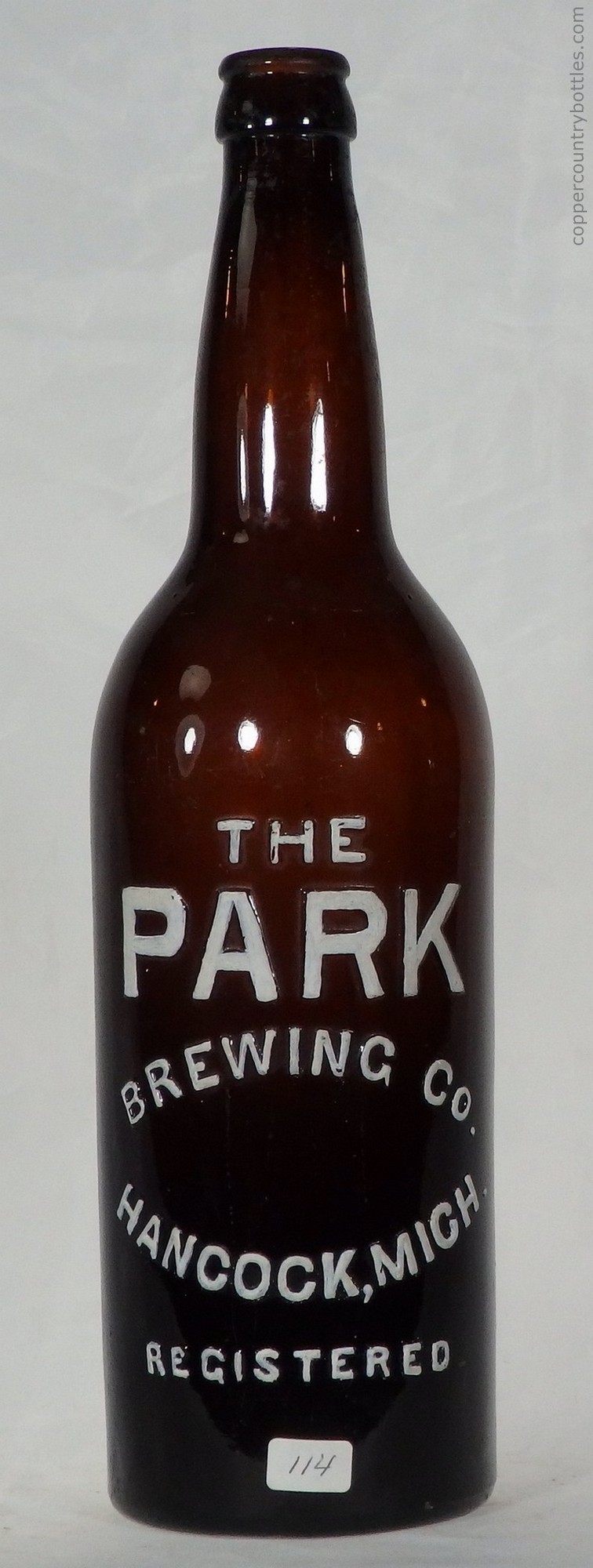
color: amber
top: crown top - tooled
base: post-bottom
maker's mark: A B Co (base)

other marks: [none]
dated: 1908
rarity: common
- export-shaped mold
- back heel has date code 8 - S
- same plate for 114 and 117

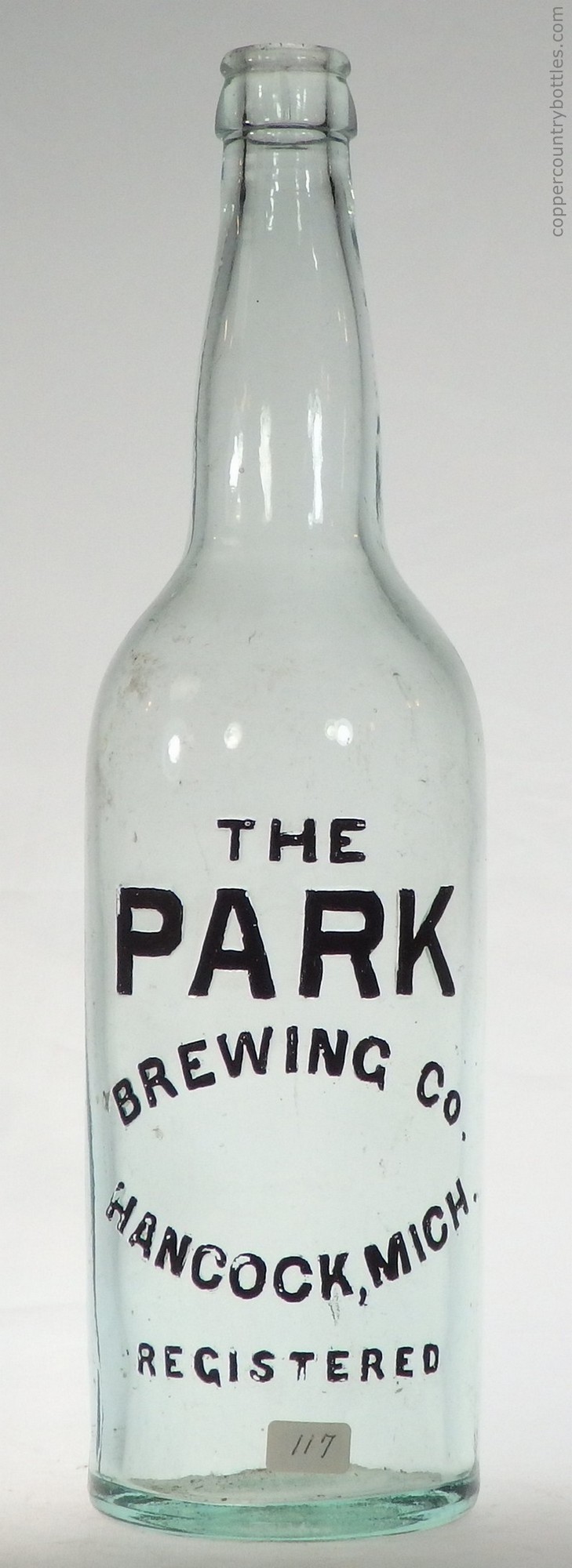
color: aqua
top: crown top - tooled
base: post-bottom
maker's mark: A B Co. (base)
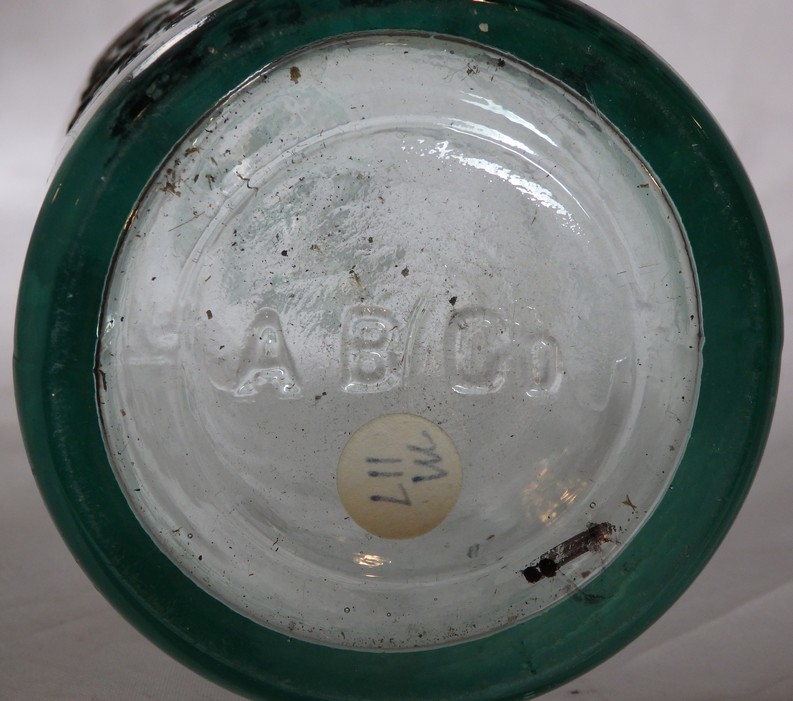
other marks: [none]
dated: 1908
rarity: common
- same plate for 114 and 117
- different color
- back heel has date code 8 - S
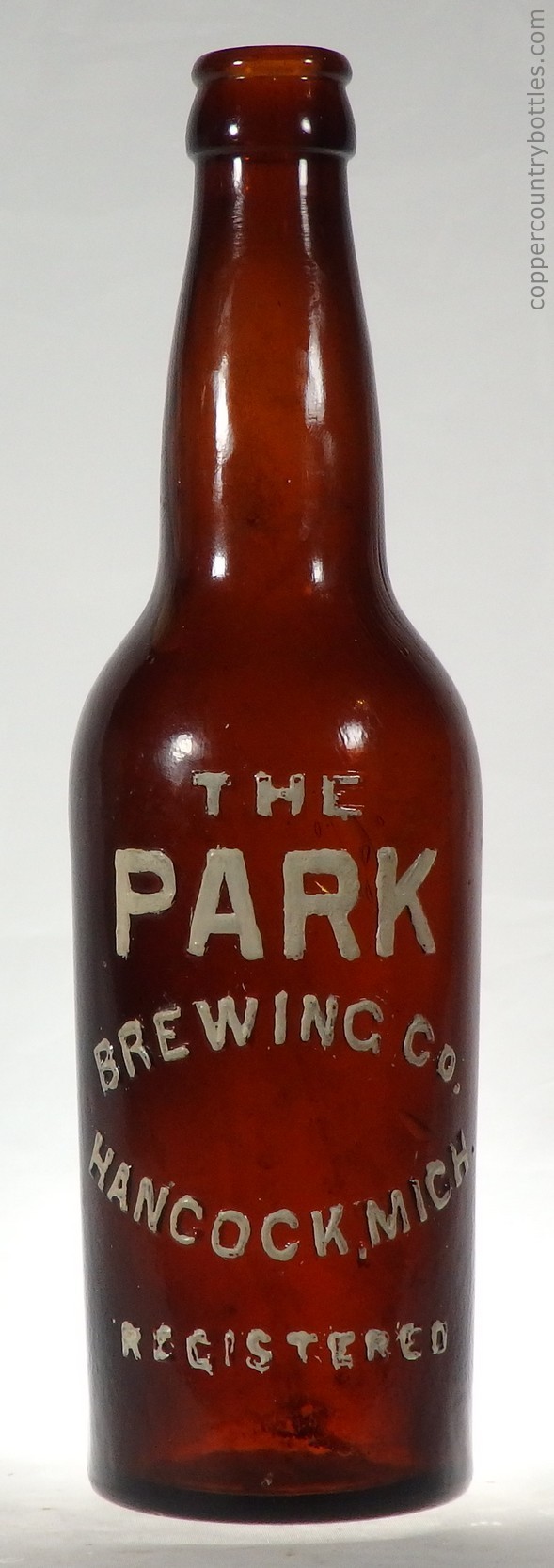
color: amber
top: crown top - tooled
base: post-bottom
maker's mark: A B Co (base)

other marks: [none]
dated: 1908
rarity: rare
- pint-sized complement to 114
- back heel has date code 8 - S
- same plate for s61 and 118

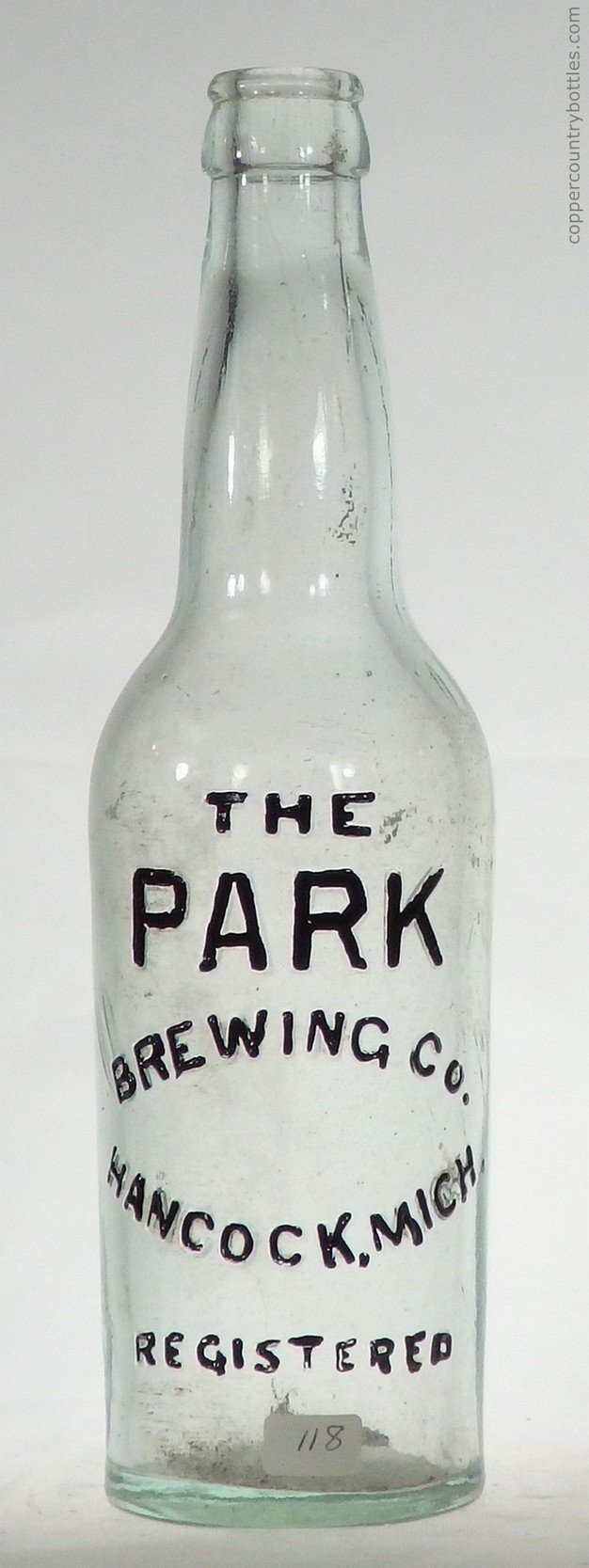
color: aqua
top: crown top - tooled
base: post-bottom
maker's mark: A B Co. (base)
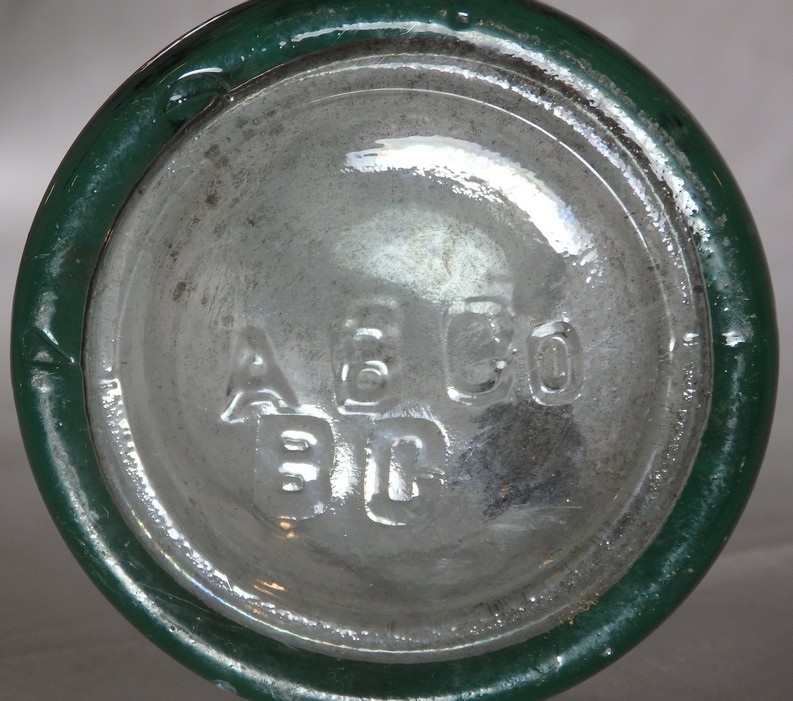
other marks: [none]
dated: 1908
rarity: common
- same plate for s61 and 118
- different color
- pint-sized complement to 117
- back heel has date code 8 - S
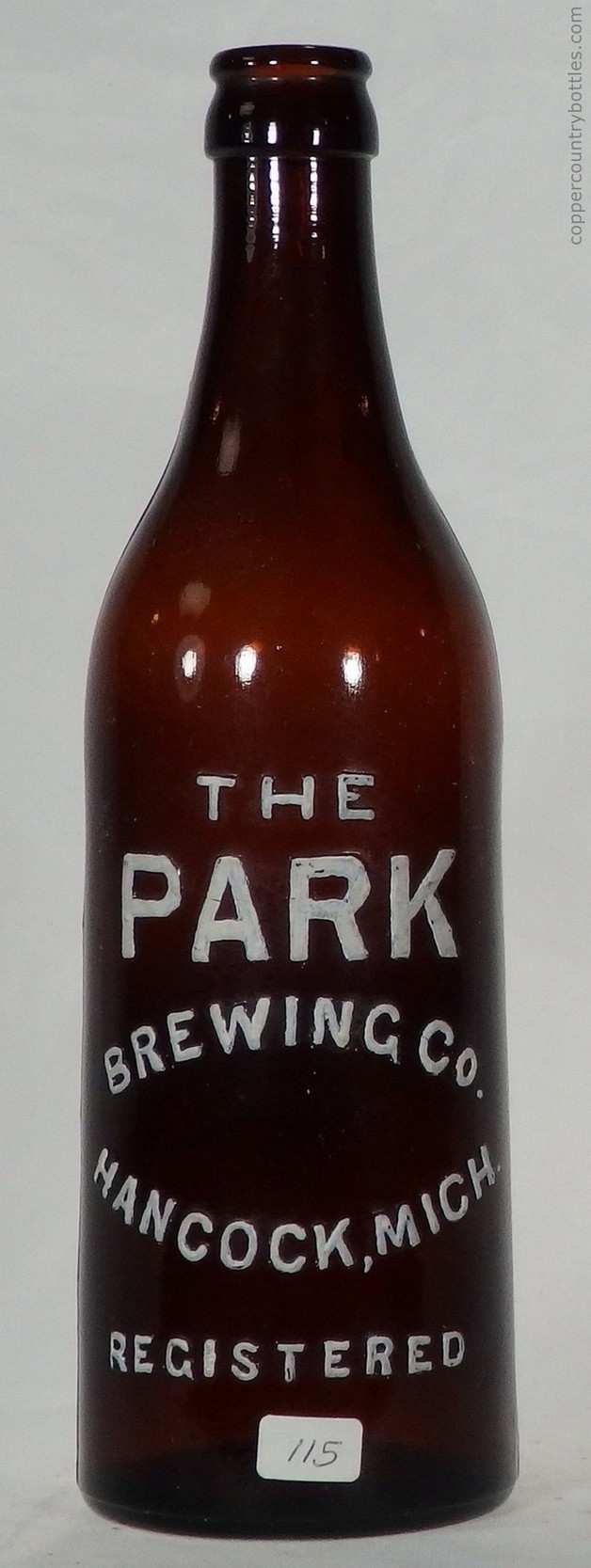
color: amber
top: crown top - tooled
base: post-bottom
maker's mark: A B Co. (base)

other marks: [none]
dated: 1910, 1913
rarity: common
- pint-sized complement to 113
- back heel has date code S - 13
- another example has date code 0 - S (for 1910)


color: amber
top: crown top - tooled
base: post-bottom
maker's mark: N B B G CO (back heel)

other marks: [none]
date: 1909–1912
rarity: common
- no THE above PARK
- uppercase "O" in CO.
- different bottle maker

color: aqua
top: crown top - tooled
base: post-bottom
maker's mark: N B B G CO. (base)

other marks: [none]
date: 1909–1912
rarity: scarce
- uppercase "O" in CO.

color: amber
top: crown top - ABM
base: post-bottom
maker's mark: W. F. & S. MIL. (base)
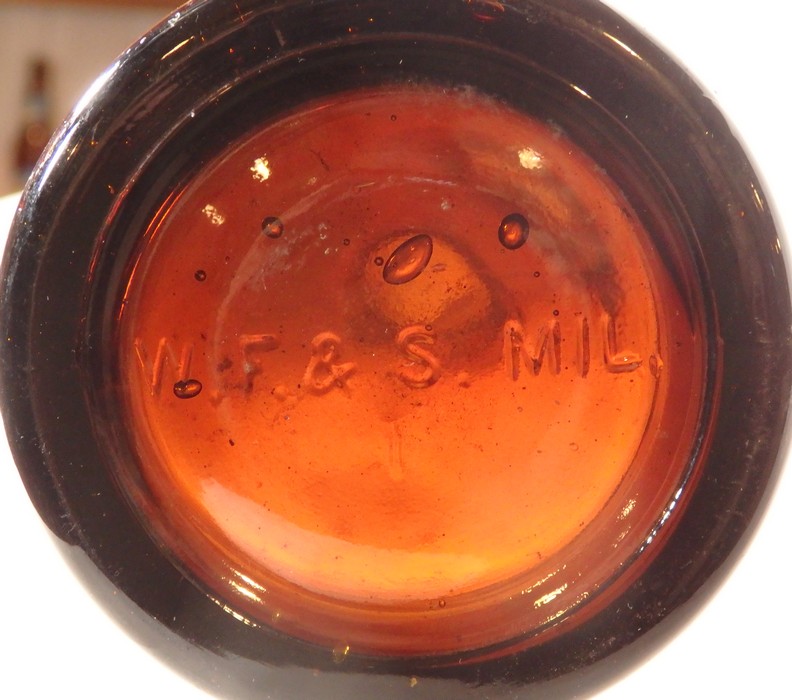
other marks: [none]
date: c. 1915
rarity: common
- T in REGISTERED under C in HANCOCK

other marks: [none]
dated: 1910
rarity: common
- different plate from abm-28
- T in REGISTERED right of C in HANCOCK
- heel has "10 12", which might be a date code

other marks: [none]
dated: 1909
rarity: common
- different plate from abm-28 and abm-28a
- lowercase "o" in Co
- THE above PARK stamped out
- heel has "9 1", which might be a date code

color: aqua
top: crown top - ABM
base: post-bottom
maker's mark: [none]
other marks: [none]
dated: 1912
rarity: common
- the heel has "12 1", which might be a date code

color: aqua
top: crown top - ABM
base: post-bottom
maker's mark: [none]
other marks: [none]
dated: 1916
rarity: common
- back heel has A B Co. date code 16 S 1

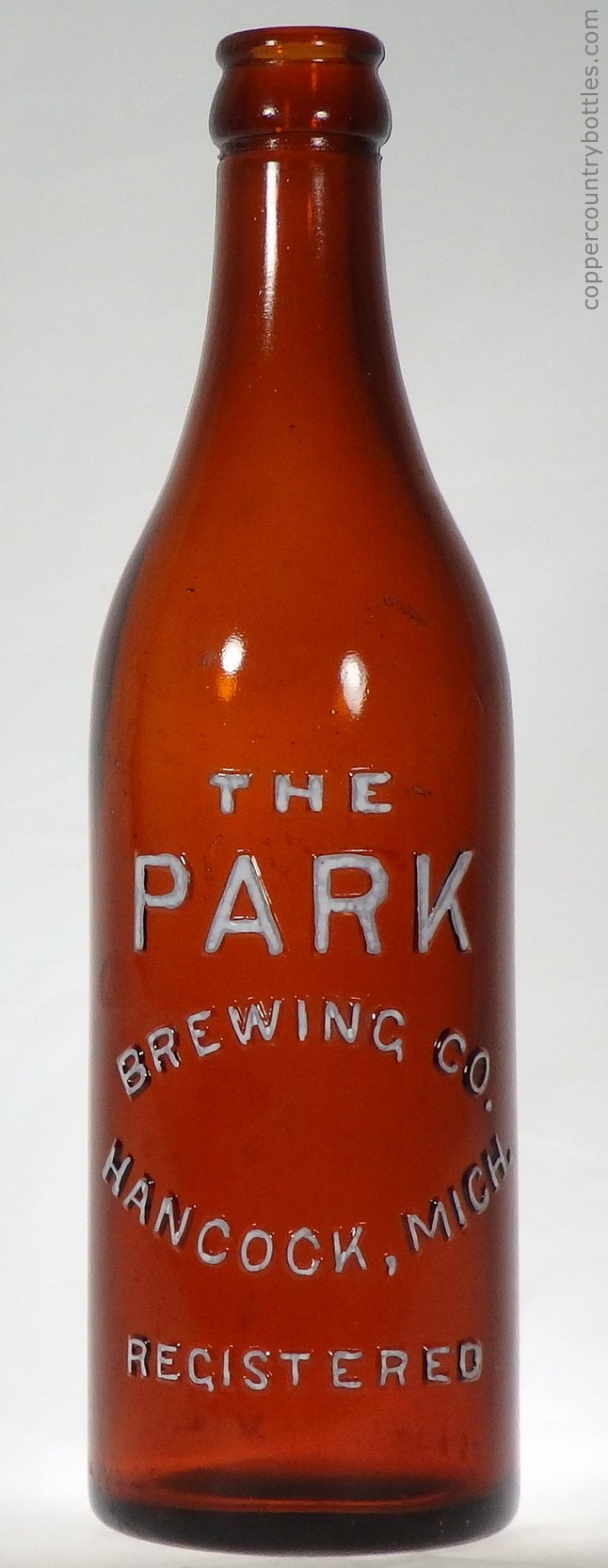
color: amber
top: crown top - ABM
base: post-bottom
maker's mark: [none]
other marks: [none]
dated: 1917
rarity: common
- back heel has A B Co. date code 17 S 1
