

18 Apr 2022, last revised 12 Nov 2025
Breweries typically used "Brewery" or "Brewing Co." as part of their name, while a "Bottling Works" typically bottled soda or mineral water. Thus, it was puzzling that Excelsior Bottling Works used beer-type bottles despite being named a bottling works. Two possibilities exist for such an occurrence: 1) someone used beer-type bottles to bottle soda or mineral water, or 2) the bottling works was a distributor for a brewery. These bottles were cataloged in the Unknown Brewers and Bottlers section of Old Copper Country Bottles, but now we have more information on their history.
.jpg)
Newspaper notice – Jan 1891
What Was Bottled and Who Was the Proprietor?
Since the Excelsior Bottling Works bottles have applied Baltimore loop seal tops, we focused our search on the late 1880s and early 1890s. A newspaper stated in Jun 1891 that Excelsior Bottling Works purchased a beer wagon (2). In May 1892, Excelsior Bottling Works was listed among the accepted liquor bonds (3). Thus, the bottling works evidently bottled beer. Unfortunately, the articles did not identify the agent or brewery by name. Conversely, the 1891 Polk directory lists George P. Hahn as a bottler in Hancock under "Mineral Water and Soda" and under "Beer", but did not identify his bottling works by name (1). The directory also lists George as a beer agent in Houghton (1). Fortunately, a notice from Jan 1891 connected the two by identifying "George Hahn, proprietor of Excelsior Bottling Works and dispenser of Milwaukee beer at Hancock" (4). In contrast to one directory listing, we found no evidence that Hahn or the bottling works bottled soda or mineral water.
George P. Hahn was born in 1864 or 1865 in Michigan (6,7), probably in Houghton, since he was listed as a resident of Houghton from 1865 (11). His father was Franz Hahn (6), who ran a brewery in Houghton under the firm F. Hahn & Bro. (8,9,10).
What Brewery Produced the Beer?
The lingering mystery is whose beer George bottled. The newspaper only stated that he was a "dispenser of Milwaukee beer". Magnaghi (5) states that George Hahn became an agent for Val Blatz Brewing Co. in Hancock, but we have not been able to confirm this with a historical document, and it seems improbable based on what we have found. Joseph Malherbe became the Blatz agent in Hancock in Jun 1890 (15), and Paul Schenk filled the agency in Apr 1892 after Malherbe resigned (16). Thus, even though a Blatz branch was in Hancock, other people were its agent during the time George was proprietor of Excelsior Bottling Works, and we have found no evidence that George was ever an agent for Blatz.
George Hahn started as a beer agent while he lived in Houghton. The 1887 Holland directory lists George as a resident of Houghton and agent for the Philip Best Brewing Co. of Milwaukee (11).
The Philip Best Brewing Co. and the Pabst Brewing Co. – Jacob Best Sr. and his four sons formed Best & Co. and started the Empire Brewery (26,27) in 1842 (28,33). Of the sons, Charles left in 1845, followed by Lorenz in 1850 (26). Late in 1851, the brewery was the first in Milwaukee to brew lager beer (26). Jacob Sr. retired in 1853 (26) and Jacob Jr. left in 1860, leaving Philip as sole proprietor (28). Frederick Pabst, Philip's son-in-law, became a partner in 1864 (28). In 1865, Emil Schandein, another son-in-law, became a partner and Philip Best retired (28). Production in 1867 was 18,011 barrels, second in Milwaukee to Blatz's 18,241 barrels (29). The company was incorporated as the Philip Best Brewing Co. in Mar 1873 with a capital of $300,000, which was increased to $2 million in 1874 (26). A newspaper ad from Dec 1875 listed depots in Philadelphia, New York, New Orleans, Memphis, Vicksburg, and San Francisco (30). In 1884, the company was the largest beer producer in the U.S. with 374,770 barrels, followed by Schlitz with 343,090 barrels and Anheuser-Busch in St. Louis with 314,080 barrels (31). On 16 Mar 1889, the company was renamed the Pabst Brewing Co. in honor of its president (32), and its capital increased to $4 million (41). By the late 1880s, Pabst was supplying 35 states, and Wisconsin accounted for 13% of its sales (34). Pabst purchased the Falk, Jung & Borchert brewery in Oct 1892 (35), which helped to boost its production to 1,052,584 barrels in 1892 (26).
George Hahn was the manager of the Houghton branch of the Pabst Brewing Co. (12). In Nov 1889, Emil G. Riewe of Minneapolis became the new manager (17,18). In Feb 1894, John Knivel succeeded Riewe as manager (21). By May 1894, the Pabst branch had been moved from Houghton to Red Jacket (22). Thus, George was no longer Pabst's agent when he was proprietor of Excelsior Bottling Works, and the Pabst branch was never located in Hancock.
In Dec 1889, George became the Houghton County agent for the Fred Miller Brewing Co. (40), which was another Milwaukee brewery, and thus a potential source of "Milwaukee beer". The news reports, however, did not say where the Miller branch was located, particularly whether it was in Hancock. It is unclear when George moved to Hancock, but he was stated to reside "in Hancock" in Nov 1888 (25), was described as "of Houghton" in Feb 1889 (24), and was described as "of Hancock" in Dec 1890 (13).
The Fred Miller Brewing Co. – Charles Best left Best & Co. in 1845 and started the Plank Road Brewery in 1850 (26). He was joined by his brother Lorenz, and their partnership continued until Lorenz died in 1853 (26). They apparently shipped beer to New York in 1852, beginning Milwaukee's export trade (26). However, the brewery failed and was idle for a year or more (36), and then Frederick Miller purchased it in 1855 (26). In 1867, Fred Miller produced 3,284 barrels, which was seventh highest among Milwaukee breweries (29). Miller established an agency in Chicago in 1867, ahead of Blatz's agency, which was established in 1870 (19). At some point, the brewery was renamed the Menomonee Valley Brewery (36), and this name being used in a newspaper ad from Jun 1876 (37). On 28 Apr 1887, the business was incorporated as the Fred Miller Brewing Co. with a capital of $200,000 (38). Fred Miller died on 11 Jun 1888, and the brewery was left to his heirs (36). In 1888, Miller was the fourth highest beer producer in Milwaukee with 80,211 barrels (39). Stack (20) classifies Miller as a regional shipper, in contrast to national shippers like Pabst, Schlitz, and Blatz.
The newspaper announced in Nov 1891 that James Ryan of Hancock became the agent of the Fred Miller Brewing Co. (23). We have not found confirmation that the Miller agency was in Hancock, especially since Hahn, Ryan, and the Miller agency were not listed in the 1893 directory (14). However, both Hahn and Ryan were residents of Hancock and agents of Miller during the time Excelsior Bottling Works was mentioned in the newspaper. Therefore, the "Milwaukee beer" was most likely from Miller.
Reflections on the Bottles
The Excelsior Bottling Works operated for approximately two years, from c. 1890 to c. 1892. While the beer was not manufactured locally, the bottles were custom-made for the Hancock branch, given that they bear HANCOCK, MICH. The rarity of these bottles suggests a small operation. The existence of three bottles with different plates, however, suggests sustained business over time. Given that they contained Milwaukee beer, the bottles signify a regional brewery's presence in the early Copper Country.
What Happened to G. P. Hahn?
George P. Hahn does not appear in the 1893 directory (14) or in any subsequent directories, so it appears he left the area. In Oct 1904, he and his wife were residents of Chicago when he visited his brother, F. W. Hahn, in Ontonagon, where he expected to relocate (42). He leased the first floor of a new building to open a restaurant (43), which was in business by Dec 1904 (44). In Feb 1905, however, they closed the restaurant and returned to Chicago "on account of the climate not agreeing with his wife" (45). In Jul 1908, Hahn and his wife were residents of New York when they visited his brother again (46). George P. Hahn died in New York on 07 Aug 1909 at the age of 44 (47). The notice did not specify what caused his death at such a young age.
Citations
- R. L. Polk & Co. (1891). Michigan State Gazetteer and Business Directory 1891-92. R. L. Polk & Co. Detroit, MI.
- About Portage Lake. (1891, Jun 25). Portage Lake Mining Gazette (Houghton, MI). p. 3.
- The liquor bonds. (1892, May 05). Michigan Copper Journal (Hancock, MI). p. 1.
- Keweenaw jottings. (1891, Jan 30). The Calumet and Red Jacket News (Calumet, MI). p. 2.
- Magnaghi, R. M. (2015). Upper Peninsula Beer: A History of Brewing Above the Bridge. American Palate. Charleston, SC.
- U.S. Census Bureau. 1870 United States Federal Census. Accessed on Ancestry.com.
- U.S. Census Bureau. 1880 United States Federal Census. Accessed on Ancestry.com.
- J. E. Scripps & R. L. Polk, compilers. (1873). Michigan State Gazetteer and Business Directory for 1873. Tribune Book and Job Office. Detroit.
- R. L. Polk & Co. (1875). Michigan State Gazetteer and Business Directory 1875. The Tribune Printing Company. Detroit, MI.
- The Western Historical Company. (1883). History of the Upper Peninsula of Michigan. The Western Historical Company. Chicago, IL.
- Holland, A. H. (1887). 1887-8 Hand-book and Guide to Houghton, Mich. Mining Journal Book and Job Print. Marquette, MI.
- About Portage Lake. (1889, Dec 12). Portage Lake Mining Gazette (Houghton, MI). p. 4.
- Local jottings. (1890, Dec 09). Torch Lake Times (Lake Linden, MI). p. 3.
- R. L. Polk & Co. (1893). Michigan State Gazetteer and Business Directory 1893-94. R. L. Polk & Co. Detroit, MI.
- Local jottings. (1890, Jun 17). Torch Lake Times (Lake Linden, MI). p. 3.
- [Untitled]. (1892, Apr 12). Torch Lake Times (Lake Linden, MI). p. 3.
- [Untitled]. (1889, Nov 14). Torch Lake Times (Lake Linden, MI). p. 3.
- [Untitled]. (1889, Nov 21). Torch Lake Times (Lake Linden, MI). p. 3.
- Andreas, A. T. (1886). History of Chicago: From the Earliest Period to the Present Time, Volume III - From the Fire of 1871 until 1885. The A. T. Andreas Company, Publishers, Chicago, IL.
- Stack, M. (2000). Local and regional breweries in America’s brewing industry, 1865 to 1920. The Business History Review 74: 435-463.
- [Untitled]. (1894, Feb 06). The Native Copper Times (Lake Linden, MI). p. 3.
- [Untitled]. (1894, May 08). The Native Copper Times (Lake Linden, MI). p. 3.
- [Untitled]. (1891, Nov 03). Torch Lake Times (Lake Linden, MI). p. 3.
- Notes from Keweenaw. (1889, Feb 05). Torch Lake Times (Lake Linden, MI). p. 3.
- Hancock happenings. (1888, Nov 29). Portage Lake Mining Gazette (Houghton, MI). p. 3.
- H. S. Rich & Co. (1903). One Hundred Years of Brewing. H. S. Rich & Co., Publishers. Chicago and New York.
- Van Wieren, D. P. (1995). American Breweries II. Eastern Coast Brewiana Association. West Point, PA.
- The Brewery. (1879, Dec 23). The Milwaukee Daily News (Milwaukee, WI). p. 4.
- Lager beer. (1868, Jan 29). Baraboo Republic (Baraboo, WI). p. 1.
- Philip Best Brewing Co. (1875, Dec 25). Philip Best Brewing Co. Empire Brewery [Advertisement] Washington Sentinel (Washington City, D.C.). p. 3.
- Annual production of beer. (1885, May 30). State Gazette (Green Bay, WI). p. 2.
- Milwaukee matters. (1889, Mar 23). The Weekly Wisconsin (Milwaukee, WI). p. 4.
- [Untitled]. (1889, Mar 20). The Daily (Beaver Dam, WI). p. 2.
- Cochran, T. C. (1948). The Pabst Brewing Company: The History of an American Business. University Press. New York, NY.
- Largest brewing company in the world. (1892, Oct 28). Daily State Gazette (Green Bay, WI). p. 1.
- Milwaukee matters. (1888, Jun 16). Weekly Wisconsin (Milwaukee, WI). p. 4.
- Menomonee Valley Brewery. (1876, Jun 17). Fred. Miller Menomonee Valley Brewery [Advertisement] Washington Sentinel (Washington City, D.C.). p. 4.
- Articles of association. (1887, Apr 28). Wisconsin State Journal (Madison, WI). p. 4.
- State news. (1889, Jan 18). The Daily (Beaver Dam, WI). p. 4.
- Hancock and Houghton. (1889, Dec 10). Torch Lake Times (Lake Linden, MI). p. 3.
- News notes. (1889, Mar 21). The Dodge County Citizen (Beaver Dam, WI). p. 2.
- Local events. (1904, Oct 08). The Ontonagon Herald (Ontonagon, MI). p. 5.
- Local events. (1904, Nov 05). The Ontonagon Herald (Ontonagon, MI). p. 5.
- Local events. (1904, Dec 17). The Ontonagon Herald (Ontonagon, MI). p. 5.
- Local events. (1905, Feb 11). The Ontonagon Herald (Ontonagon, MI). p. 5.
- Local events. (1908, Jul 11). The Ontonagon Herald (Ontonagon, MI). p. 5.
- Local events. (1909, Aug 14). The Ontonagon Herald (Ontonagon, MI). p. 5.
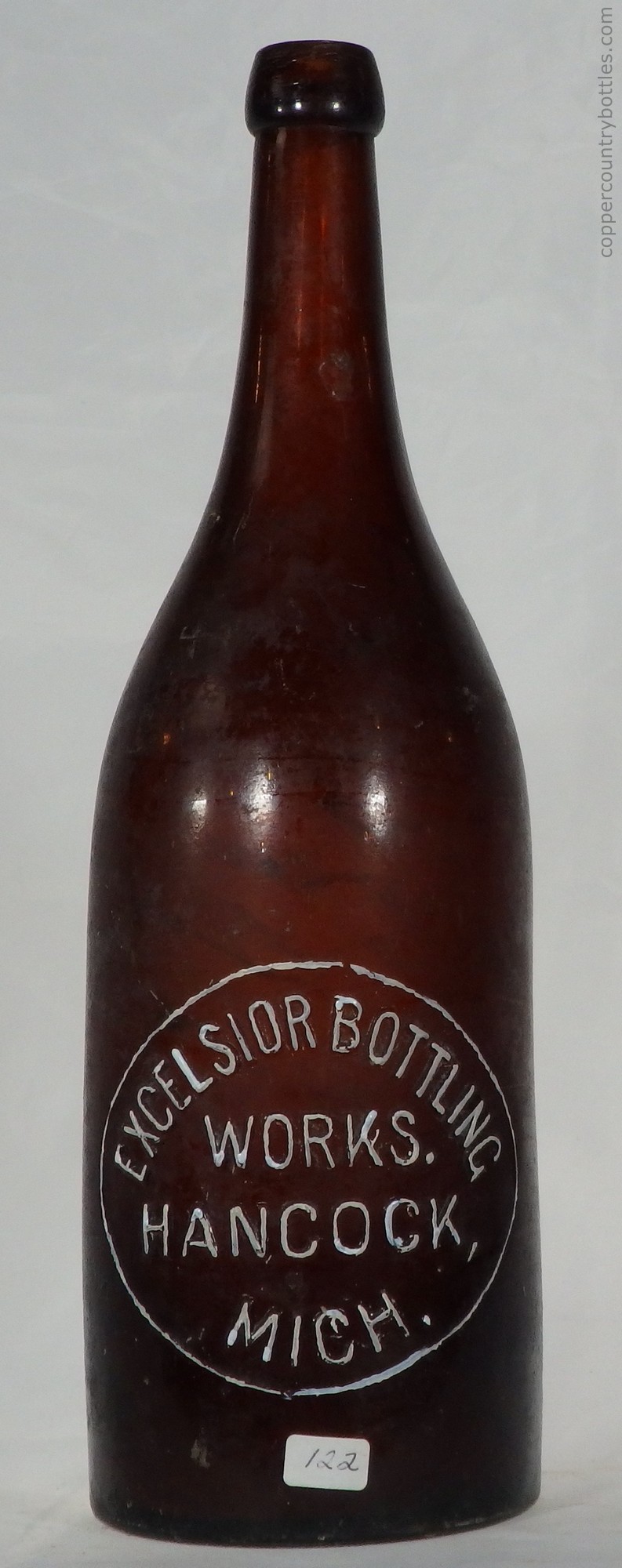
color: amber
top: Baltimore loop seal - applied
base: post-bottom
maker's mark: [none]
other marks: NOT TO BE SOLD OR TRADED (back)
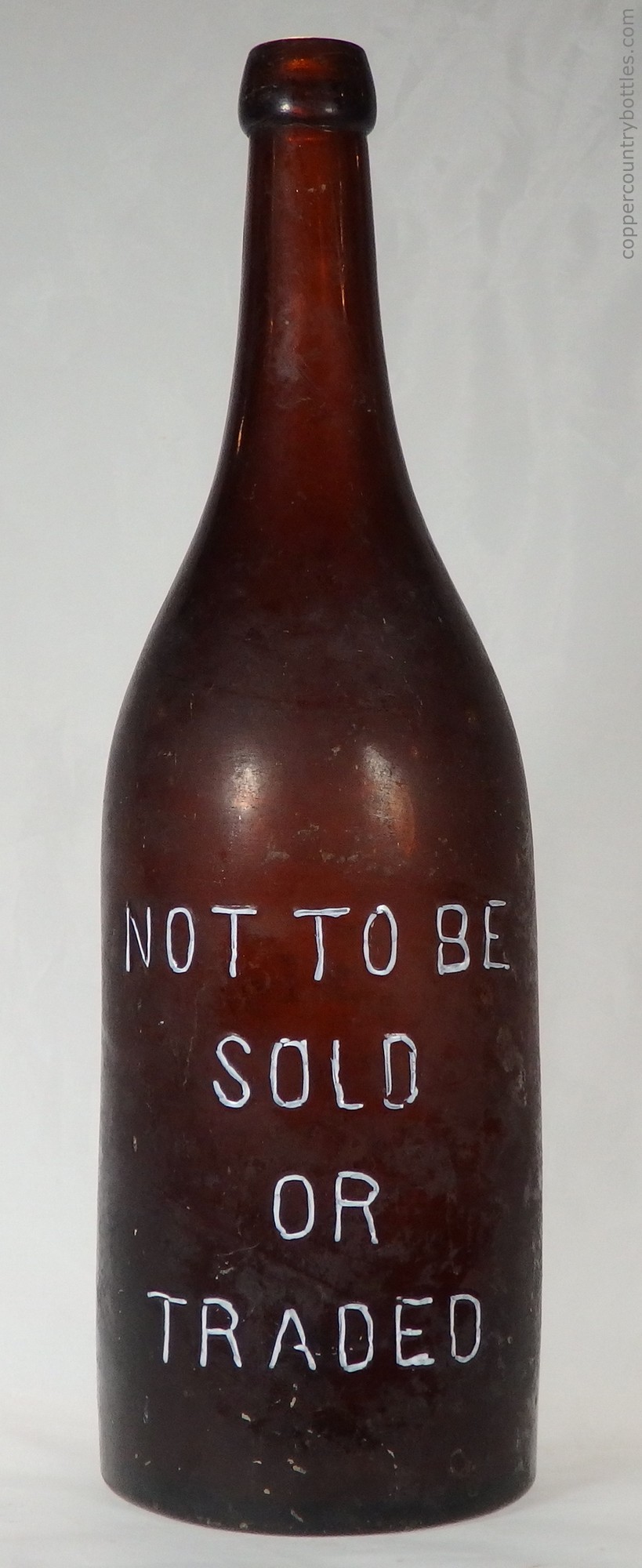
date: 1890–1892
rarity: extremely rare
- exceptionally large plate
- plate low on mold
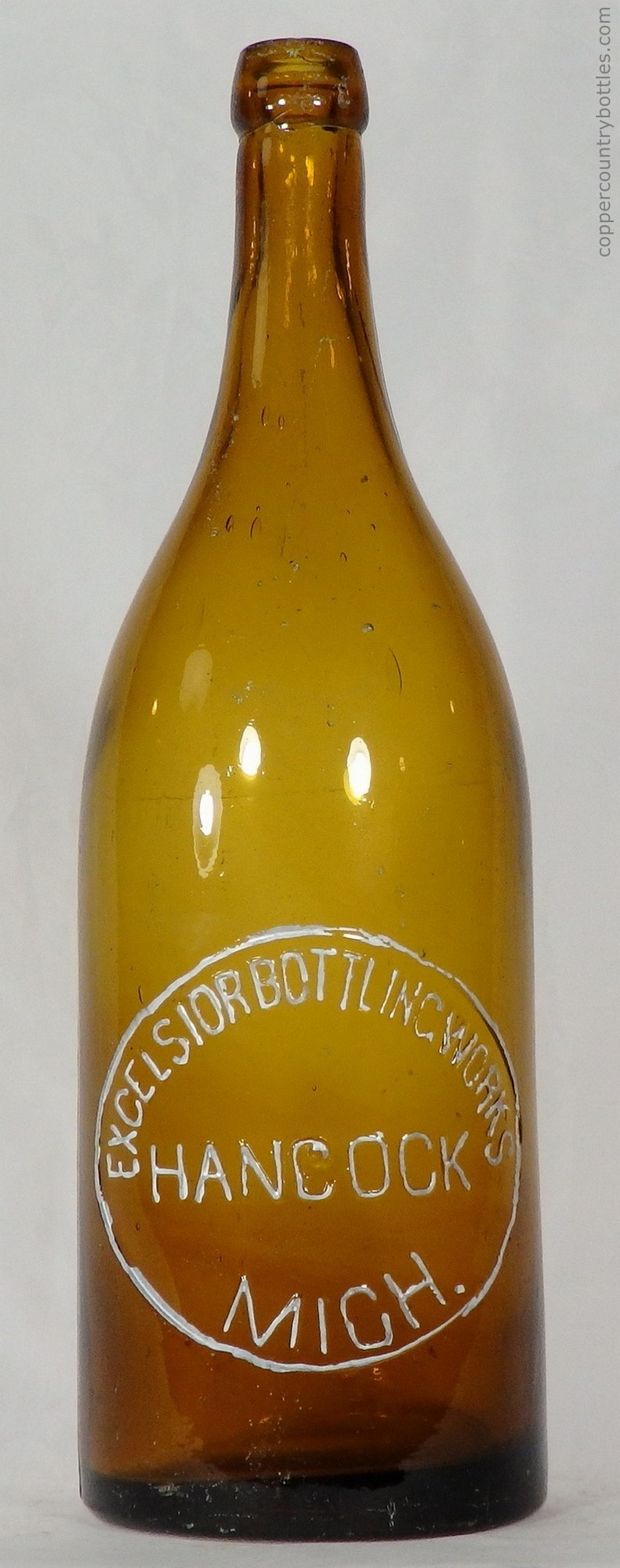
color: amber
top: Baltimore loop seal - applied
base: post-bottom
maker's mark: [none]
other marks: [none]
date: 1890–1892
rarity: extremely rare
- different plate design
- exceptionally large plate
- plate low on mold
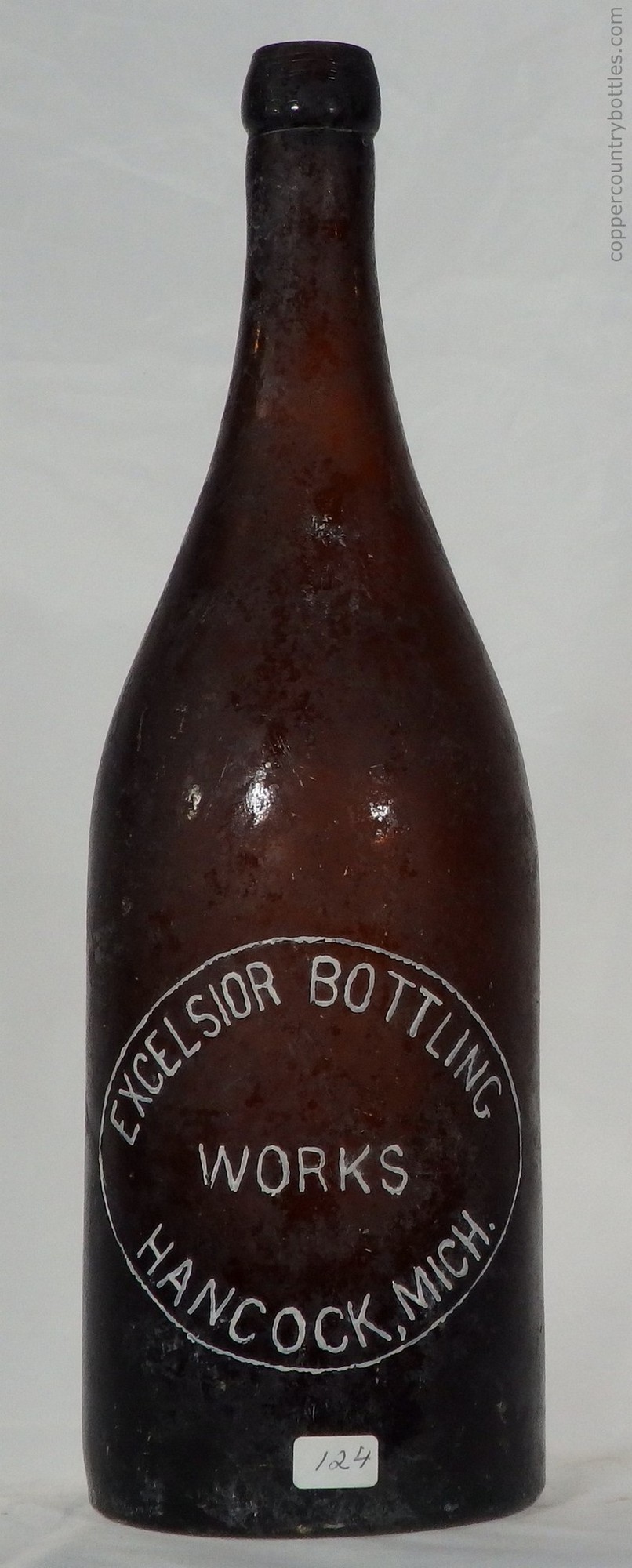
color: amber
top: Baltimore loop seal - applied
base: post-bottom
maker's mark: [none]
other marks: THIS BOTTLE NOT TO BE SOLD (back)
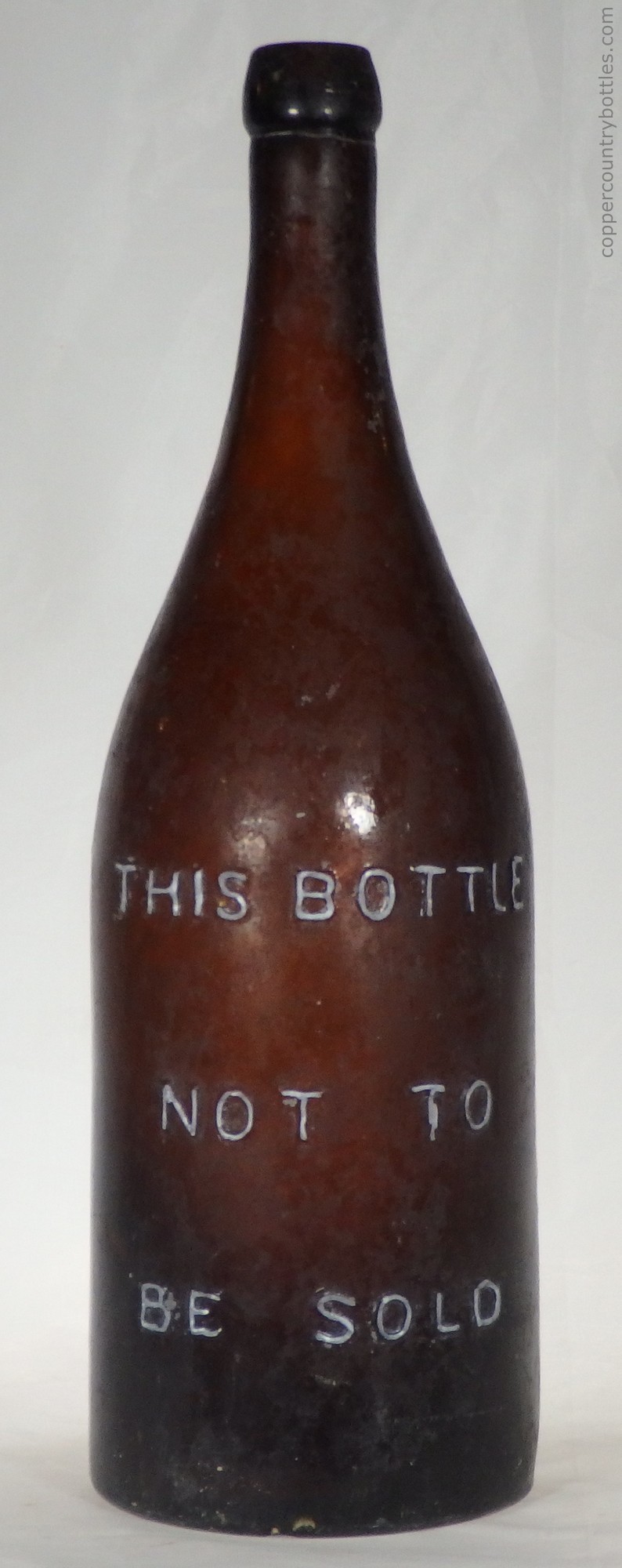
date: 1890–1892
rarity: extremely rare
- different plate design
- exceptionally large plate
- plate low on mold